

$17,000 in Energy Bills: When History Comes Up Against Conservation
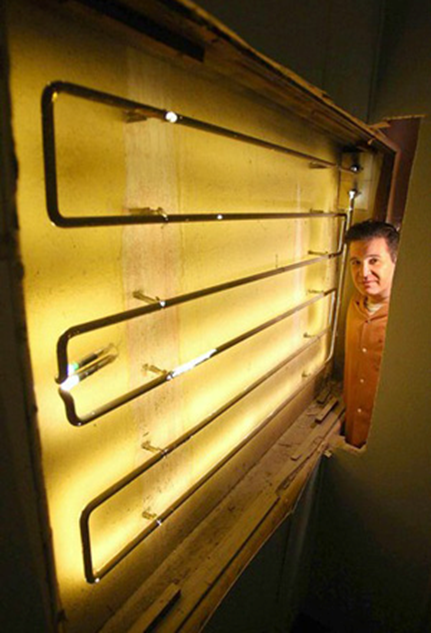
Andrew Meieran and the neon sign that has remained lit for over half a century (via LATimes.com).
June 20, 2012 — Imagine his surprise when Andrew Meieran, owner of Clifton’s Cafeteria, a restaurant in downtown LA, saw a faint glow from the wall in an otherwise pitch-black storeroom. Investigating further, he peeled away the partition to uncover an ancient neon sign. The sign, which is estimated to be from 1935, was used to light up an early décor of the restaurant, but was covered during remodeling. It is unclear why the sign was never turned off, but it remained lit for the ensuing 77 years. The sign is a historical treasure, but also an energy fiend, and reflects many of the issues of today’s digital billboards.
The former owners of Clifton’s Cafeteria saved everything, so the recent renovations have uncovered not only ancient signs, but playbills, journals, and sheetrock autographed by construction workers, along with a plethora of other artifacts since the Great Depression. Historians and preservationists alike are touting the discovery, as Meieran intends to keep the items in the renovated restaurant and display them as part of its past.
A different take on being energy-conscious (via RecycleReminders.com).
The discovery also sheds light on energy saving. The $17,000 estimation serves as a shocking and important reminder that lights left on can rack up exorbitant amounts of money. Digital billboards, for example, can drain up to 30 times the energy of the average home in the United States. Advocates of digital billboards cite the potential advertising profits,
For the sake of history, the light in Clifton’s Cafeteria may be worth the cost. Meieran has decided to leave this particular sign lit in its original home, but this sign, like digital billboards, will continue to be a costly addition in terms of energy.
As Meieran’s discovery highlights, energy-using signs are no new thing. As they grow in size, technology, and spread, digital signs have become a discussion about the use of advertisements and energy conservation in the US.
– K. Howitt