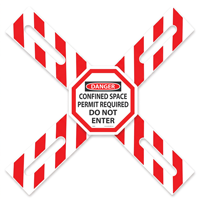
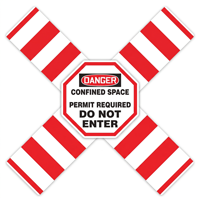


A do not enter sign means the entrance is closed to everyone, not just to unauthorized visitors. In a facility it marks a door, opening, or area where entry is prohibited outright, usually because a hazard on the other side makes the space unsafe to walk into, or because an operation inside cannot be interrupted. The sign carries the international prohibition symbol, a red circle with a 45-degree diagonal bar over a black pictogram, which the ISO 7010 series standardizes as the no-entry marking. That symbol is what lets the sign work for a worker, a visitor, or a contractor who does not read English.
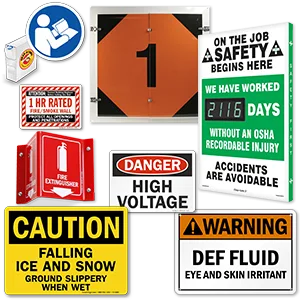
Match the header on a do not enter sign to what is actually behind the door, using the ANSI Z535.2 ladder that OSHA 1910.145 recognizes. DANGER on red is for an immediate hazard that will cause death or serious injury if someone walks in, such as an energized electrical room, an arc flash boundary, or a confined space. WARNING on orange covers a hazard that could cause death or serious injury. CAUTION on yellow covers a lower-severity hazard, such as an area where equipment moves. NOTICE on blue is the right header when there is no physical hazard at all and the sign is stating a company access rule, which is where most office, storage, and server-room do not enter signs belong. Using DANGER for a policy rule weakens every real DANGER sign in the building, so keep the ladder honest.
Post a do not enter sign at eye level on the door or opening itself, on the side people approach from, so it is read before anyone reaches the handle. The usual locations are electrical and mechanical rooms, chemical and flammable storage, confined space entry points, roof and ladder access, server and equipment rooms, and any machine enclosure or guarded area. Outside the building, post at fence gates, dock approaches, and the perimeter of a work area. Keep the sign face unobstructed, since a sign hidden behind stacked material or a propped-open door is not a posted warning.
Do not post a do not enter sign on a door that serves as an exit or that people would need during an evacuation. OSHA 1910.37 governs exit routes, and it requires the opposite marking in a related case: any doorway or passage along an exit access that could be mistaken for an exit, such as a closet or storage room, must be marked “Not an Exit” or be identified by a sign showing its actual use. Applied together, the rule is straightforward. Mark real exits as exits, mark look-alike doors for what they are, and reserve do not enter signs for entrances that are genuinely closed. Never use one in a way that discourages someone from leaving through a required egress door.
A do not enter sign closes the entrance to everyone approaching it. A restricted access sign means entry is limited rather than forbidden, so trained or badged people may pass. An authorized personnel only sign says the same thing and names the condition explicitly, which is why it suits doors that staff use daily and visitors never should. Choose do not enter when the answer is no for everyone, and choose the other two when the answer is yes for some. Posting do not enter on a door your own team walks through every shift trains people to ignore the sign.
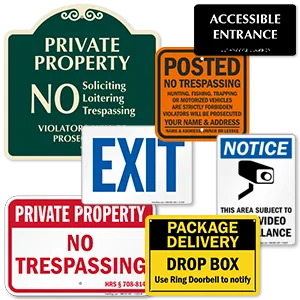
A do not enter sign addresses a specific entrance; a no trespassing sign addresses the property as a whole. Post do not enter at the door, gate, or opening you are closing, and post no trespassing and keep out signs along a boundary, at a driveway, or on a fence line to give notice that entry onto the property is not permitted. Property owners commonly use both: boundary notice at the perimeter, and a specific prohibition at the doors and hazards inside. Posted notice is what puts an intruder on the wrong side of the line, and requirements for how and where to post vary by state.
For machine and vehicle areas, use a do not enter sign that names the condition, since the hazard is intermittent rather than constant. A Do Not Enter When Equipment Is Operating message works on a machine enclosure or robotic cell, because it tells someone the rule changes with the machine state. At forklift aisles and dock edges, pair a wall or post sign with do not enter floor signs or floor marking, since people watch the floor in a busy warehouse. Add forklift signs and traffic-flow markings so foot and vehicle routes are separated rather than merely labeled.
Choose the material by where the sign lives and the size by how far away it must be read. Plastic is fine for an indoor door at close range, and aluminum is the choice for outdoor gates, docks, and anywhere the sign takes weather or washdown. Size follows reading distance: a door sign read from a few feet away can be small, while a sign at a gate or across a warehouse bay needs to be large enough to read from where a person or vehicle must stop. For unlit stairwells, plant rooms, and areas that lose light in an outage, we recommend a glow-in-the-dark or reflective format so the prohibition stays visible when the power does not.
Yes. Bilingual do not enter signs carry English and Spanish together, and Peligro No Entre versions are available where Spanish is the primary language on site. Symbol-only formats using the hand or figure graphic communicate without text at all, which is the right pick for a mixed-language crew or a site with contractors and visitors. A custom sign lets you name the room, add your company name, or state the specific rule, such as who to call for access. For a facility-wide or multi-site order, call our team at (800) 952-1457, Monday through Friday, 8:00am to 7:00pm EST, or email customerservice@smartsign.com for a quote.
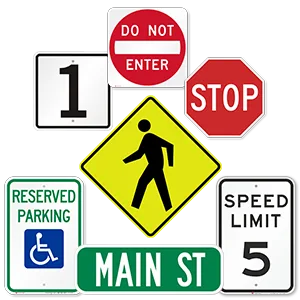
The red square road sign is the MUTCD R5-1 regulatory traffic sign, and it is a different system from the OSHA and ANSI facility signs on this page. Traffic signs follow the Manual on Uniform Traffic Control Devices, which sets their size, retroreflectivity, and mounting for public roads, one-way streets, ramps, and parking garages. For those applications, see do not enter traffic signs at our sister store We. Use the signs on this page for facility doors, restricted rooms, hazard areas, and private property entrances.
We make do not enter signs for facilities and property. A do not enter sign closes an entrance completely, which is what separates it from a restricted access sign that lets authorized people through. Post them on doors to electrical rooms, chemical storage, confined spaces, mechanical and server rooms, roof access, and machine areas, and at the boundaries of forklift aisles, loading docks, and construction zones. Every sign carries the internationally recognized prohibition symbol, a red circle with a diagonal bar, so the message reads before the words do.
Call our sales team at (800) 952-1457 and get your quote in minutes!
Mon - Fri 8:00am to 7:00pm EST
Best price guarantee. Fast, free shipping.