



OSHA 1910.133 requires eye and face protection wherever workers face hazards from flying particles, molten metal, liquid chemicals, acids or caustics, chemical gases or vapors, or injurious light radiation. An eye protection sign enforces this rule at the entrance so workers gear up before exposure. Missing signage is a common eye-protection citation and a preventable injury waiting to happen.
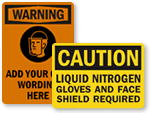
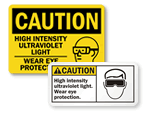
Welding produces intense light and flying sparks, so it needs more than safety glasses, a filtered-shade lens (a welding helmet or goggles rated under Z87.1) and often a face shield. Post a welding eye-protection warning at the bay, and pair it with face shield and UV/arc radiation signage so the specific protection is clear.
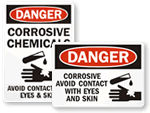
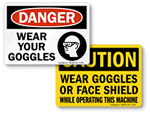
Chemical splash calls for sealed goggles, not safety glasses, because goggles form a barrier around the eyes. Post a goggles-required sign where liquids, acids, or caustics are handled, along with corrosive-material and avoid contact warnings so workers pick the right protection for the hazard.
Where corrosive chemicals are present, OSHA 1910.151(c) requires suitable eyewash or drenching facilities for quick flushing of the eyes, and the ANSI Z358.1 consensus standard calls for a station reachable within about 10 seconds along an unobstructed path, with its location clearly marked. A visible eyewash-station sign is how workers find it fast in an emergency, see our first aid and emergency signs.
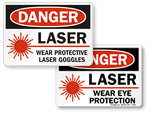
No. Laser hazards are governed by ANSI Z136 and require laser-specific warning signs plus laser-rated eyewear matched to the beam's wavelength and optical density — standard eye protection won't stop a laser. Use dedicated laser warning signs for those rooms and reserve general eye protection signs for particle, chemical, and impact hazards.
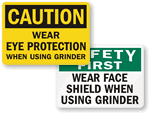
Look for OSHA-listed hazards: grinding, machining, or chipping (particles); chemical mixing or transfer (splash); welding or UV (radiation); and dusty processes. Any of these triggers the eye-protection requirement, and the entrance needs a sign. A quick hazard walk-through tells you which specific type of protection is needed.
Post them so a worker sees the requirement before reaching the hazard, at every entrance and repeated within large areas, at eye level (roughly 4 to 7 feet) in a well-lit, unobstructed spot. The rule is line-of-sight before exposure. No one should reach the particle or splash zone before seeing the sign. Choose a size legible at the distance workers approach.
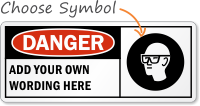
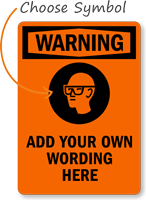
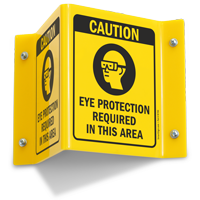
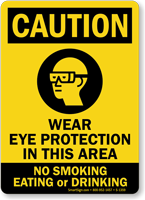
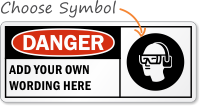
Match the header to the severity, pair it with the correct pictograph (glasses, goggles, or face shield) so it reads without words, and keep the message short and specific: "Eye Protection Required" or "Wear Goggles." Use reflective or bold-contrast material for visibility, and add your shop's exact rule on a custom ANSI eye-protection sign.
Yes. Bilingual English/Spanish signs make sure every worker understands the rule, and a custom sign lets you specify the exact protection and area. For a facility-wide set — matched hazard-specific signs across every zone — call our team at (800) 952-1457 (Mon – Fri, 8:00am to 7:00pm EST) or email customerservice@smartsign.com for a quote.
We make eye protection signs that tell workers to protect their eyes before entering areas with flying-particle, chemical-splash, welding, or radiation hazards. We have eye hazard signs that span the full range of recognized hazards and precautionary measures: safety glasses for particles, goggles for splash, face shields and welding warnings for high-energy work, available in stock, custom, and bilingual formats.
Call our sales team at (800) 952-1457 and get your quote in minutes!
Mon - Fri 8:00am to 7:00pm EST
Best price guarantee. Fast, free shipping.