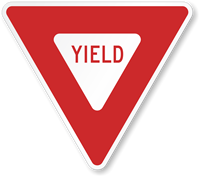
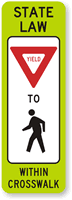
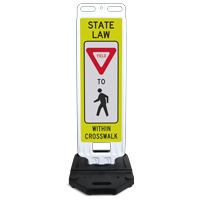
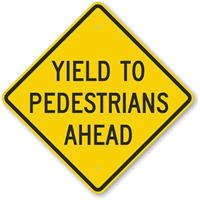
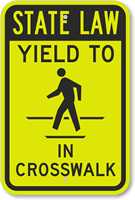
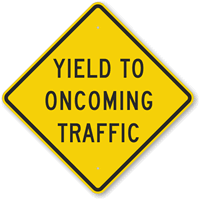
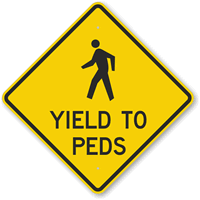
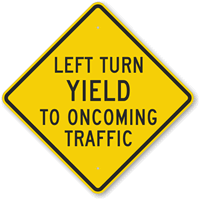
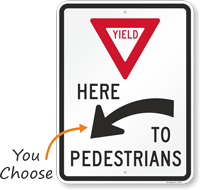
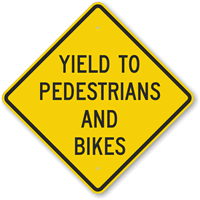
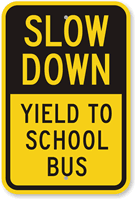
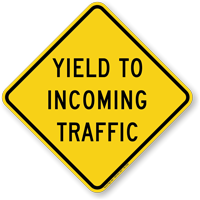
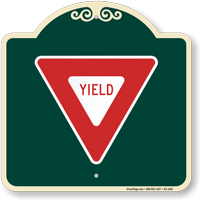
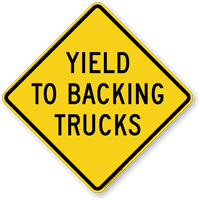
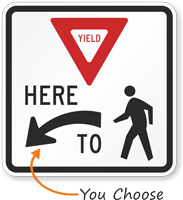
A yield sign is a regulatory sign that assigns the right-of-way. When you reach a yield sign, slow down and let vehicles that arrived first, pedestrians, and bicyclists approaching from another direction pass before you proceed.
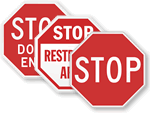
Both yield signs and stop signs define the right-of-way, but a yield sign does not require a complete stop - you slow down and let others pass. At a stop sign, a driver must come to a full stop at the line or risk being cited.
At a yield sign, the driver facing the sign gives the right-of-way to traffic on the main road, oncoming traffic, and pedestrians in the crosswalk. You proceed only when there is a safe gap; the vehicles you are yielding to go first.
If there is no traffic or pedestrian to yield to, a yield sign lets you continue through without a full stop, as long as you have slowed enough to stop safely if needed. That is the key difference from a stop sign, which requires a complete stop every time.
A yield sign at a roundabout entrance tells you to give the right-of-way to traffic already circulating in the roundabout. Wait for a safe gap in the circulating traffic, then enter - you do not stop unless the traffic requires it.
Yield signs are installed at roundabout entrances, to control a merge onto an entering roadway, on the second crossroad of a divided highway, and in place of a stop sign where drivers can see conflicting traffic in time to pass through or stop safely. Their design and placement are governed by the MUTCD.
Yield signs are red and white today - a white downward triangle with a wide red border and "YIELD" in red. They were yellow until 1971, when the standard changed to the red-and-white MUTCD R1-2 design, which is why the question still comes up.
Failing to yield the right-of-way at a yield sign is a moving violation on public roads and can bring a traffic ticket and points on a license. Beyond citations, failure to yield is a common cause of intersection and merge collisions.
Yield signs are made from rust-free.080" aluminum faced with 3M reflective sheeting that meets ASTM D4956, in Engineer Grade, High Intensity Prismatic, or Diamond Grade. Diamond Grade sheeting is 3M's brightest, with about three times the reflectivity of high-intensity sheeting and roughly ten times that of engineer-grade sheeting, for strong day and night visibility.
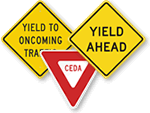
A yield ahead sign (a yellow warning sign) is posted before a yield sign to warn drivers that a yield is coming and they need to slow for the right-of-way. It is used where the yield sign itself is hard to see far enough in advance.
We are the leading maker of yield signs. A yield sign is the MUTCD R1-2 regulatory sign - a downward-pointing red-and-white triangle - that tells drivers to give the right-of-way, slowing down and stopping only if another vehicle or a pedestrian is coming. Unlike a stop sign, a yield sign lets traffic keep moving when the way is clear, which is why it is used at roundabout entries, merge lanes, and low-conflict intersections. Every yield sign is made from rust-free.080" aluminum with 3M reflective sheeting, so it stays readable day and night.
Call our sales team at (800) 952-1457 and get your quote in minutes!
Mon - Fri 8:00am to 7:00pm EST
Best price guarantee. Fast, free shipping.