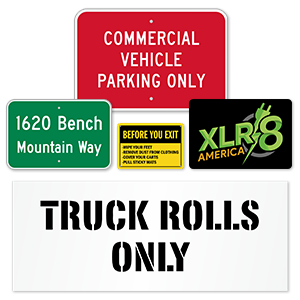
When you design your custom labels using one of our label wizard templates, we will provide an online proof of the design. You design your labels online and the proof is instantaneous. For uploaded designs, we typically will also provide you a proof.
As long you quickly review the proof for errors, graphics, your custom label order will not be delayed.
Yes, just give us a note when you place the order. Some customers just show where they want a check box by typing two brackets (for example "[_]"). We offer free design service for your custom tag design, so you can always just fax us a sketch.
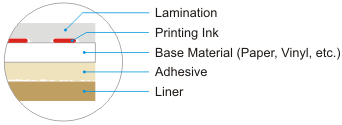
Custom labels, typically, have the following parts:
• Lamination. This is top layer and optional. Lamination adds to the cost of a label and is generally only used when the application requires special durability. This lamination (sometimes called an “overlamination”) is clear and typically made from clear polyester, acrylic or polypropylene. In most cases, the lamination is glossy and the lamination is not writable.
• Base Material. This is the main label component (and is often called the custom label’s “face stock”). Paper is most common, but other base materials include vinyl, paper, polypropylene and polyester.
• Adhesive. The next layer is the adhesive layer. Common adhesives are either solvent-based (more costly and, generally, better performing) or water-based (more affordable). The range of adhesive choices can quickly become rather daunting – so please call up our LabelLab experts if you want to learn more.
• Liner. The bottom layer is [most often] a throw-away paper liner. The liner has a “release coat” on one side that allows the liner to be removed from the adhesive easily.
Yes, having semi-permanent asset labels for computers and laptops is a great idea. You may want to sell your computers or apply a new asset tag. In this application, we recommend our AlumiGuard™ asset tags. While permanent and very difficult to remove by a casual user, these asset tags can be removed with the proper tools. It is kind of like shucking an oyster! Use a knife and pry underneath the asset tag. The metal asset tag should come off. Any residual adhesive from your asset tag can be removed with an adhesive remover.
Our programmers can add an asset tag template just for you. We can place your asset tag template under the My Designs area.
To answer you second question first, because it is so simple, the answer is yes. The only difference will be in the material we print it on – we will use a more opaque white, because it will provide better color visibility on both sides of the banner. Another option is to put two banners back-to-back. We will even sew them together for you if you would like! Just let us know. The advantage of the back-to-back method is that you get the less opaque white material, and you could separate the two sides if you ever felt like it.
As far as size goes, the size of the text is much more important than the size of the banner. See the size chart for text visibility. But a general “rule of thumb” is that every inch of text can be seen 25 feet away. In short, your banner size will depend mostly on how much text you want to have on it. Another often overlooked but critical factor in determining visibility is the color contrast. Make sure that text stands out from the background, and it will be much easier to read.
| Letter Size | Viewing Distance |
| 1" | 40 ft. |
| 1.25" | 55 ft. |
| 1.5" | 65 ft. |
| 2" | 85 ft. |
| 2.5" | 115 ft. |
| 3" | 135 ft. |
| 4" | 150 ft. |
| 6" | 200 ft. |
| Letter Size | Viewing Distance |
| 8" | 350 ft. |
| 9" | 400 ft. |
| 10" | 450 ft. |
| 12" | 525 ft. |
| 15" | 630 ft. |
| 18" | 750 ft. |
| 24" | 1,000 ft. |
| 30" | 1,250 ft. |
The characters must be in capital letters. Here is an excerpt from the ADA rules (section 4.30.4 ): Letters and numerals shall be raised 1/32 in, upper case, sans serif or simple serif type and shall be accompanied with Grade 2 Braille. Raised characters shall be at least 5/8 in (16 mm) high, but no higher than 2 in (50 mm). Pictograms shall be accompanied by the equivalent verbal description placed directly below the pictogram. The border dimension of the pictogram shall be 6 in (152 mm) minimum in height.
California Braille is a spacing and dot height standard which is different from the Library of Congress standard Braille spacing. It has nothing to do with translation or meaning, like the distinction between contracted (Grade 2) versus standard (Grade 1) Braille. All signs are written in Grade 2 Braille. In California, Grade 2 Braille specifications for spacing and height were modified specifically for signs. Designed by a leading expert (who is, in fact, blind), the California spacing was calculated to be easier to read. Beginners and elderly people, who have less training in Braille or less sensitive fingers, could still read the simple text on signs (such as "Male" or "Exit" or "203") and find the right door.
The California Braille standard is legal in 49 other states too. There are no federal regulations on spacing and dot height in conflict with the California standard. All of our ADA signs are made with California Braille, and we strongly recommend using this standard for your signs.
There are many issues to consider before you choose a printer, and the most important is knowing exactly how you'll be using your printer. Is it for a school or university? Is it for a secure organization? Is it for one-at-a-time company IDs?
All of our Evolis printers are designed for particular needs. Our Securion model, for example, is specially designed for secure laminated ID printing, ideal for large, high-security facilities that may require unique holograms or special card protection. The Quantum is built for high-speed bulk printing, which is great for a large-scale organization that can benefit from fast, simple ID card prints.
If you are a smaller organization, our best-selling Pebble4 is a user-friendly option for high-quality single-sided prints. Take a look at our specs for more information, and consider exactly what you want out of your ID card printer.
There is good reason why we recommend Evolis Genuine Ribbons for your Evolis printer. Not only are our ribbons designed especially for particular Evolis models, but every ribbon is quality-tested before shipping, so you know you aren't just getting a good printer ribbon or laminate, you're getting the best.
We also offer the widest range of hologram, BlackWAX and scratch-off ribbons, as well as patches and laminates for all of your printing needs.
Emergency egress signs must be illuminated, as their sole purpose is to guide the path to safety in case of fire or a blackout situation. You must use glowing Exit signs to meet codes and standards, especially UL 924 regulations.
In addition to your glowing Exit sign system, it is highly recommended to use glowing text for other instructional safety signs that are vital in an emergency situation.
The ADA requires that Braille tactile signs be included in all new buildings, but every Exit does not require Braille signs. In some states, religious institutions and private clubs are not regulated by accessibility standards. Federal guidelines do not impose any restrictions on these private organizations.
However, more and more signs are now ordered with Braille, and varies slightly state-by-state. Certain states have laws that require religious buildings and private clubs to comply with accessibility standards. Most religious institutions want to be as welcoming as they can, and they are usually ahead of the crowd in providing ADA compliant restrooms, signs, and entrances.
Since you work in a public institution, you will need Braille accompanying your Exit sign. Raised Braille characters must be at least 5/8" (16mm) high, but no higher than 2" (50mm).
These color choices are based on building codes that vary state-by-state. Most U.S. states require the color red; however, parts of California, Oregon, Washington State, Colorado and International codes require green signage. We offer both options to accommodate the needs of your state. Take a look at our state-by-state information, and call your local fire marshal for a personal, local recommendation.
Whatever you do, don't rely solely on tape. To meet building codes, your sign must have at least two wall-mount screws, only one of which can be keyhole-shaped. We recommend using four tamper-proof holes for the safest, sturdiest mount, and adhesive backing is great for initial positioning. Our signs include four pre-drilled holes, for a better hold and increased tamper resistance.
NFPA 101 (Life Safety Code) compliance involves not only the type of sign, but the way it is installed and its precise location. All of our Exit Signs will already have the UL 924 seal on it, which is determined at the point of manufacture.
NFPA-recommended graphic symbols, such as the running man graphic, are helpful additions to your UL924 signage. However, NFPA regulations are merely recommendations, and it is up to your fire marshal to enforce them. While NFPA 101-compliant signs are not required, they are widely and increasingly used across the country to communicate vital, universal instructions.
We offer a number of glowing and non-glowing graphic signs that reach across language barriers, provide vital instructions and save time in an emergency situations.
EXIT letters should be no less than 6" high (8" in New York) with a 3/4" stroke (letter thickness). We offer Exit signs with both 6" and 8" lettering to comply with your state codes and regulations.
Use a bi-directional EXIT sign if your facility has more than one exit path. Use arrows to point to each exit from a centrally-located sign; otherwise, a unidirectional sign will point to your single exit.
Here's an example: imagine you are in a T-shaped hallway, where one exit path is 20 feet away and another exit path is 40 feet away. Your Exit sign should point to both possible Exits, in the case that one is blocked during an emergency.
Even though one Exit is closer than the other, it is vital to mark both Exits for a dire emergency situation. This is when you need to use a bi-directional Exit sign.
For more information, read our FAQ for Bathroom Signs installation and requirements.
Yes, our signs are approved in Canada.
Canadian regulations are the same as U.S. regulations. You will find the Canadian code titled "ULC" instead of "UL;" however, the U.S. and Canadian regulations do not differ.
An edge-lit sign has illuminated edges, and this feature is typically found on electric LED signs. Photoluminescent signs are not edge-lit, since it is not required locally or statewide in the U.S.
Edge-lit signs are not as durable as solid acrylic signs, for example; however, they do provide additional directional light sources and add a contemporary look to many Exit signs.
Photoluminescent signs will shine brightly for more than 20 years. As previously mentioned, a dirty environment will compromise the ability of the photoluminescent pigment to absorb and store light. If your establishment gets dirty, we recommend that you wipe your photoluminescent signs regularly to achieve maximum illumination in an emergency.
As an alternative, Tritium signs will require no additional source of electricity, and soil will not affect its luminescence as severely.
You can use a bilingual or Spanish Exit sign wherever you feel that your environment can benefit from it. There is no regulation as far as federal or state laws that require the use of bilingual signs, but you have to consider the people who will use the facilities when deciding whether or not to use a bilingual sign. Is another language the primary conversational language of employees or visitors?
Are there bilingual schools in the neighborhood? In these cases, you will want to consider using a bilingual sign.
If you choose a biligual Exit sign, always take language equality into consideration. You want to be sure that the bilingual signs you order do not feature one language much larger than the other, or that they present drastically different messages. While different fonts, colors, and terms will make your sign more effective, the goal is to make both languages equally helpful and never a hindrance to its readers.
Self-luminuous signage typically refers to Tritium signs, which is a radioactive material that is a viable light source. Tritium signs may not require an internal power source, but they do require radioactive disposal when you no longer need them.
Our photoluminescent signs use Safety-Grade Strontium Oxide, which is not radioactive and is safe to use anywhere.
The ADA requires that Braille tactile signs be included by stairwell doors. Raised characters must be at east 5/8" (16mm) high, but no higher than 2" (50mm). Pictograms must be accompanied by a verbal description placed directly below the pictogram. The border dimension of the pictogram must be a minimum of 6" in height.
Doors that are neither exits nor egress pathways, but may appear as though they are safe exits must be identified as "NO Exit," according to Section 7.10.8.3 of the Life Safety Code. The code requires the word, "NO" to be 2 inches (5 cm) high and the word "EXIT" to be 1 inch (2.5 cm) high so that the occupants will not focus on the word "exit."
These doors may also be labeled to avoid the potential for confusion. For example, a door to a storage room could be label "Storage Closet" so that people know that it's not an exit.
In any case, common sense must be used when choosing where to put an Exit Sign. While your fire marshal will have a very specific recommendation, you can also ask yourself: are there redundant signs? Can multiple signs be seen from the same viewing angle? Ultimately, your job is to get people out as quickly as possible, but you don't want to buy more signs than you need, either. A good rule of thumb is to stand at any point in your facility and ask yourself, "can I see a sign that points toward an exit?" If you see more than one exit sign -- it doesn't hurt anyone!
Most buildings do not have readily available power sources where low-level exit signs need to be installed. Moreover, these low-level signs need to be durable. They are kicked, carts run into them, and they are often subjected to water and cleaning agents.
Since low-level mounts are required along the entirety of your egress exit paths, it would be incredibly expensive to install the LED electric system down your entire stairwell. Unlike the dated Tritium self-luminating signs, photoluminscent signs will emit no radioactivity if kicked or mishandled. Photoluminescent signs offer the most dependable, durable, and inexpensive choice for low-level and egress Exit path systems.
Yes, many Fire marshals are requiring low-level Exit signs in addition to your high-level signs. Recent standards have changed, explicitly, in many states, such as Connecticut and New York, and we believe that low level mounting will soon become the norm.
The reasons for low level mounting are obvious. Smoke rises and too often obscures an-above-the-door exit sign. Sophisticated building managers insist on egress markings near the floor. This can dramatically increase the chances of everyone leaving the building safely, and is just good common sense, on top of it being required in many states and municipalities.
Exit Signs are wired internally, inside of your wall. They are always plugged in. Power cords for home use only.
Generally, yes, this is true. And, as you have guessed, this could mean some serious electrical work. For this reason, we see many building owners, when faced with various retrofit options are now buying photoluminescent signs. They require no wiring.
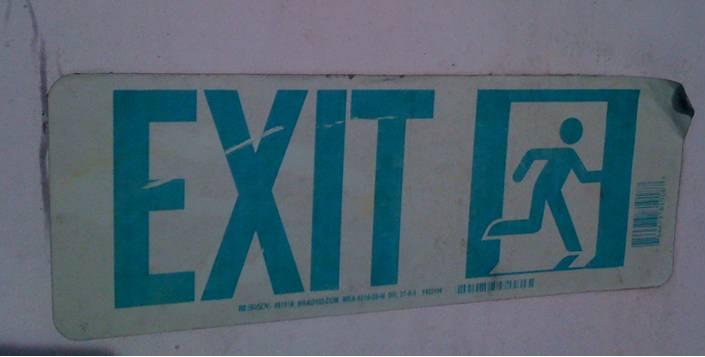
UL924 exit signs need to be mechanically fastened to the wall or ceiling – so that generally means aluminum. Other egress markers can be aluminum, plastic or adhesive pressure-sensitive. The issue of longevity really depends on the environment. Inferior signs will start to chalk or fade if exposed to sunlight, water or other chemicals. See this example (and here show the photo below) of a competitor’s sign. Also, adhesive signs tend to “flag” more often. This happens at the corner of a sign and the sign starts to “lift- off”. Generally, our signs are laminated (to protect the graphics), use an exceptionally durable ink and have an aggressive adhesive that resists flagging.
You generally need to check your battery every six months. Checking your battery vital -- at the World Trade Center, the fire department determined that over 70% of their batteries did not work properly (in other words, they could not light a sign for 90+ minutes). Checking your Exit Sign batteries are just as important as your fire alarms, so add it to your schedule!
Only 5 ft. candles are needed for a photoluminescent exit sign to glow properly. If you are not familiar with candle ratings -- that's almost too dark for you to see in! Most hallways have 25-30 fi candles of light when the lights are on.
Generally, photoluminescent signs absorb most effectively from flourescent light and natural light.
These color choices are based on building codes that vary state-by-state. Most U.S. states require the color red; however, parts of California, Oregon, Washington State, Colorado and International codes require green signage. We offer both options to accommodate the needs of your state. Take a look at our state-by-state information, and call your local fire marshal for a personal, local recommendation.
NFPA 101 (Life Safety Code) compliance involves not only the type of sign, but the way it is installed and its precise location. All of our Exit Signs will already have the UL 924 seal on it, which is determined at the point of manufacture.
NFPA-recommended graphic symbols, such as the running man graphic, are helpful additions to your UL924 signage. However, NFPA regulations are merely recommendations, and it is up to your fire marshal to enforce them. While NFPA 101-compliant signs are not required, they are widely and increasingly used across the country to communicate vital, universal instructions.
We offer a number of glowing and non-glowing graphic signs that reach across language barriers, provide vital instructions and save time in an emergency situations.
Generally, yes, this is true. And, as you have guessed, this could mean some serious electrical work. For this reason, we see many building owners, when faced with various retrofit options are now buying photoluminescent signs. They require no wiring.
Photoluminescent signs do not require 24-hour lighting, but state codes requires that lights be on at all times when the building is occupied. The signs themselves only require a few minutes of light exposure to operate in darkness.
Since you should already have your lights on during operating hours, this should not add to the total cost of ownership.
The maintenance recordkeeping should indicate more than just the service technician's name. See NFPA 10: "Each fire extinguisher shall have a tag or label securely attached that indicates the month and year the maintenance was performed, and that identifies the person performing the work, and identifies the name of the agency performing the work."
Our custom fire extinguisher service tags also ask you to define a permit number.
First, note that the monthly interval may be adjusted, "... extinguishers shall be manually inspected at a minimum of 30-day intervals or electronically monitored. Fire extinguishers shall be inspected at more frequent intervals when circumstances require." [NFPA 10]
The particular inspection information is often the following: [NFPA 10]
(1) Location in designated place
(2) No obstruction to access or visibility
(3) Pressure gauge reading or indicator in the operable range or position.
(4) Fullness determined by weighing or hefting for self-expelling type extinguishers, cartridge operated extinguishers and pump tanks.
(5) For wheeled extinguishers, the condition of tires, wheels, carriage, hose and nozzle shall also be checked.
(6) For non-rechargeable extinguishers using push-to-test pressure indicators, test the indicator.
Let's go back in time a bit. During the 80's, the color coding was rather straight-forward. Calibration legends were in green; "Rejected" used red; and, various inventory and sample labels used black. Over the last ten years, however, these color meanings have eroded. We now sell Calibration labels in 12 different colors. Each month, for example, may have a different color-code for their calibration labels. More and more calibration labels are printed locally, at the users' own laser or ink jet printers. As such, colors have lost some of their original meanings and "industry standards" (at least regarding colors) are far more flexible.
We have several hundred label dies and many of these are not listed on our custom label Quoters or wizards. If your special shape, however, does not match a die within our library, we then have two choices. In one option, we will just digitally cut your labels. This eliminates the cost of a label die. A label die may cost from $100 to $500, depending upon complexity and label type.
The second option is to order a special die for your shape. Please contact us and, together, we can determine the best option.
Call us up at 800-952-1457 and follow the prompts for customer service, We would be delighted to help you through the process of designing your custom label. We always invite your suggestions on how to make our custom label programs better.
Note that the Hazard Communication Standard is performance-oriented standard. As a result, you will not find specifications on the exact design for our Right-to-Know label (or even your MSDS). Thus, labels and MSDS' follow many different formats and there can be no side-by-side comparison made between the information placed on the MSDS versus a label.
To gain more insight, however, review the following excerpt from a July 25, 1991 letter from Patricia K. Clark, Director, Directorate of Compliance Programs at OSHA:"A material safety data sheet is not an "appropriate hazard warning"; the purpose of a label under the HCS is to serve as an immediate visual warning of the hazards associated with the chemical. The identity of the chemical leads to the more detailed information on the MSDS, but the hazard warning gives immediate information to employees working with the substance about the hazards associated with exposure."
Of course, an entire MSDS cannot fit onto your RTK label. Vital information can be lost in the clutter of a badly organized label. RTK labels should make searching through the MSDS easier. A label is, a just a single component of your hazardous communication system. No doubt, it is the tangible evidence of a RTK system that spans not only the chemical database, your MSDS's, emergency response protocols and protective equipment and handling training. For many of the comprehensive label designs that we offer in our custom RTK label section, each area of a label links to a particular section of the 16-part MSDS. By creating a way to connect the label and the MSDS, and adding an MSDS reference to the label, the MSDS becomes less intimidating.
RTK labels are not written to cover every exposure situation. Instead, they are made for the worst-case situations. Many times that Safety Officer can decide to make the PPE requirements more flexible when a substance is handled in small enough quantities that they do not present any danger.
Here are a few examples:
• In situations when small quantities are used, a lab coat or apron is adequate enough to shield the body from contamination. However, many labels still have the full body suit symbol and are written for the worst-case exposure situations as a precaution. Full body suits are generally used to protect one from liquid a corrosives as well as other liquids and solids that can potentially harm the host human, and gases which have the ability to invade the body through absorption or form corrosive mixtures with moisture.
• It is recommended that gloves be worn at all times when handling chemicals. This is a principle rule when managing with various gases. Many gases, when placed under extreme pressure or very low temperatures turn into liquids. Should these compressed gases be released and make contact with a human, frostbite will likely occur. Gloves are greatly suggested for that reason, as well as to stop one from touching their eyes while chemicals still reside on their hands.
Yes, we have several designs that allow you to add a photo to your lockout tag. Adding your photo to your tags is a terrific idea and increasingly popular. With the cost of digital camera dropping it is very easy to create and then print a small photo.
Many electrical departments find that personalized lock-out tags not only help you find someone, especially when you have so many contractors on site, but help convey the singular immediacy of the electrical hazard.
I have even seen examples of electrical workers using pictures of their own children. For example, a tag had this type of photo and the message, "My Dad's Life is on the Line. Do Not Operate!").
Most of our tags use plastic tie wraps. In general, we do not recommend strings. For a bit of background, see the following letter from John Miles, Directorate of Compliance Programs at OSHA: [excerpt only]
"Specifically you requested clarification on the possible use of a cotton-rayon cord of more than 60 pounds (13.49 Newtons) breaking strength or a nylon cord of more than 100 pounds (22.48 Newtons) breaking strength for attachment of tagout devices to energy isolating devices for the purpose of complying with the tagout requirement at 1910.147(c)(5)(ii)(C)(1).
"By 1910.147(c)(5)(ii)(C)(1), the employer is required to provide a means of tagout device attachment having the general design and basic characteristics of being at least equivalent to a one-piece, all environment-tolerant nylon cable tie. The Lockout/tagout standard uses performance language in imposing the above requirement. As such, an employer must be prepared to demonstrate equivalency to the OSHA Compliance Safety and Health Officer on inspection of his or her worksite.
"In your letter you provided a sample tag with samples of the cords described above. The cords, alone, would not meet the following means of attachment requirements in 1910.147(c)(5)(ii)(C)(1). Tagout device attachment means shall be of a non-reversible type, self-locking and non-releasable with a minimum unlocking strength of no less than 50 pounds (11.14 Newtons). Neither the cords nor the tag appear to be all environment-tolerant, that is, if wet, neither would hold up."
Different mats hold water for two primary reasons: the ridge depth of the mat pattern and the pile height of the fabric material. The ridge depth allows water and soil to settle below the shoe print and keeping dirt and moisture away from your floor. The height of the material that is affixed to the mat allows a mat to hold more water. The longer the pile and the deeper the ridge depth, the more the floor mat will hold. The WaterHog™ series boasts deep ridges and pile height to hold more water and dirt than the competition.
Our Custom Logo Mats are made from long-wearing, static-dissipative nylon and should only be used indoor or under well covered outdoor areas. Since we use a detailed, custom printing process, the vibrant colors of your custom logo are best preserved in a controlled environment.
All of our custom mats, safety mats, and other varieties are shipped using UPS ground shipping. Charges can vary by the size and weight of the mat. You will be shown your shipping charges at the time of your mat purchase.
Our mats are all manufactured here in the United States and are backed with a 100% Satisfaction Warranty.
Use the Gripper Backing for mats that are placed on hard surfaces. The gripper backing provides extra surface area for the mat to rest on, providing better protection from mat slippage. On carpeted surfaces, choose an underlayment depending on your type of carpet. All interior and entrance mats have this option.
Yes! Our Big Number parking permits feature extra-large numbers and lettering that can be seen from security vehicles and more!
Also, our brightly colored permits grab attention. With a bold color and large text, we give you the best combination of compact-sized parking permits and highly visible letters and numbers. There are no extra charges to add numbers to your parking permits, and all of the numbering is consecutive and unique, so you'll never have to worry about duplicates.
We also offer permits with glow-in-the-dark numbering for even better nighttime visibility. At night, the date of the permit glows brightly and acts as a validating watermark for the parking permit tag.
No. Our customer service personnel will be happy to give you more information about obtaining authenticated handicapped parking permits. These permits are not sold to individuals. If you are legally permitted to have this restricted permit, contact us for more information and we will help you get everything you need. For critical applications, it is best to design custom handicapped permits or to control your handicapped parking with unique permit numbers that are easy to trace by your organization.
This hole can be used for suction cups – which can be ordered separately. The suction cups are a good option when a car has not interior (rearview) mirror. Certain vans, for example, do not have a rearview mirror.
Yes, this is very easy. Just give us the information that you want and we can produce a proof for your approval. Also ask about our parking violation manila and NCR tags. These two-part tags can also be customized with your name.
Many of our customers ask for a specific color. Specify a PMS number or send us a color chip to match. For most materials, there is no extra charge for a special color match – but we will confirm this with you prior to printing.
The photoluminescent pigment will store and emit light for the entire life of your sign. However, a dirty environment will decrease the overall life of your sign and its overall brightness. If you keep your Exit sign clean and avoid wear-and-tear, it can last for 20 years or more.
Remember, photoluminescent signs are only as bright as the light they are able to absorb. If the sign is dirty, it will absorb less light and decrease in brightness over time.
Signs that are rated for greater distances than 50 feet are generally reserved for large spaces or exceptionally long hallways, since two 50' signs would be enough for a 100' long room. Since the standard visibility rating is 50 feet, most customers stick with the standard.
Given the configurations of 75' and 100' visibility signs, they are rarely used or recommended.
While a glowing background will create an illuminated halo around the sign, glowing letters produce the same effect and are just as visible as glowing background signs.
Glowing letters are also more legible in the dark, and draw attention to the wording and directionals than background-glowing signs.
Today, LED and Photoluminescent signs fulfill very different needs. While the costs of each can vary significantly, photoluminescent signs will cost less to install and operate, will last longer, and are better suited for low-level mounting.
Why are photoluminescent signs better for low-level mounting? Since low-level mounts are required along the entirety of your egress exit paths, it would be incredibly expensive to install the LED electric system down your entire stairwell. Unlike the dated Tritium self-luminating signs, photoluminscent signs will emit no radioactivity if kicked or mishandled. Photoluminescent signs offer the most dependable, durable, and inexpensive choice for low-level and egress Exit path systems.
Photoluminescent signs contribute to these three LEED standards: EA Credit #1 – Energy and Atmosphere: Optimizing Energy Performance MR Credit #4 – Materials and Resources: Recycled Content ID Credit #1.1 – Innovation in Design: Exceptional Performance Since photoluminescent signs do not require an internal electric source and absorb the light that surrounds them, they are inevitably a "green" option for your establishment.
This depends on the needs of your environment. A two-sided Exit sign is designed for centrally located installation in hallways or large rooms, so that the sign can be seen from almost every part of the space. A flat-mount is made to mount directly above doors, or on a wall that can point visitors toward an exit path. A flag-mount sign is also used in long hallways to point visitors toward an exit, although it is not usually posted close to the Exit itself.
Photoluminescent signs do not require 24-hour lighting, but state codes requires that lights be on at all times when the building is occupied. The signs themselves only require a few minutes of light exposure to operate in darkness.
Since you should already have your lights on during operating hours, this should not add to the total cost of ownership.
While it is not required, it is recommended that all safety equipment use photoluminescent safety signs in case of a blackout emergency. Go ahead! Take a look at some glow-in-the-dark fire extinguisher signs glowing fire extinguisher signs and make the most of your safety equipment by lighting the way for everyone.
Remember: in an emergency, seconds count. Photoluminescent safety signs are an inexpensive way to highlight safety equipment for a fast and effective emergency safety system. Don't take your fire extinguisher equipment for granted!
Some kinds of light are absorbed into the pigment better than others. Typically, flourescent, mercury vapor, and natural sunlight charges the best. The pigment absorbs light along the UV spectrum, which is offered in abundance by these kinds of lighting. Sodium and Incandescent lights will not work well with photoluminescent pigments.
You can use the wheelchair graphic in conjunction with a ramp graphic. In fact, we think that it is quite intuitive to do so when it is appropriate. But just remember - use good judgment when deciding what signs to install. We only recommend installing a "wedge" ramp graphic below the wheelchair pictogram when there is actually a ramp in that area. But, there is no regulation about this except that accessible restrooms must display the wheelchair pictogram.
Yes, there are two symbols in common use. They are the ISA and the SEGD.


There is no legal set of pictograms defined by the federal or state governments for restroom signs. The common "Man" and "Woman" gender pictograms that you see everywhere are called DOT pictograms. They were standardized by the US Department of Transportation (e.g. the "DOT"). Most restroom signs use these DOT pictograms.
For the visually impaired, however, there are sometimes concerns that the Woman and Man pictograms look too similar at a distance. Alternative designs have been offered by several people. But none of these designs (other than the California Title 24 designs) seem to have developed legs. They have not developed a following; the DOT pictograms predominate.
Installing a Safety Scoreboard is extremely simple – they are made to give you as many options as possible for mounting them. Our scoreboard is designed with two holes positioned at the top for easy mounting. The most common method is to place two hooks in the wall, where you want to install your scoreboard. But, really, you can mount the unit onto anything that works for the space you have – hang it with wire, nails, weld it onto something, or even just sit it on a ledge! There are a few critical considerations that we ask you to remember, however. For electronic scoreboards, you should place your Safety Scoreboard less than six feet away from a 120 V power source. And for Indoor/Outdoor models we remind you to be conscious of the electric hazard of an outdoor installation and use a GFI outlet.
We offer aluminum sign blanks in two alloys, 5052-H38 and 3105-H191. We carry multiple guages (thickness) including .040", .063", .080", .100", and .125". All aluminum is processed in-house to better control quality. We level, treat, cut, punch and radius aluminum coils into road sign aluminum blanks, all within our 65,000 square foot production facility.
Yes, these diamond grade stop signs are much more costly. But, they are increasingly popular. Use them for high traffic areas, areas with plenty of other visual distractions, or, when you want superb durability. Many sign companies [and even film manufactures] have been heard to complain that diamond grade signs last too long. With a warranty of 12 years, we have seen most stop signs last longer. Some states even have their DG3 signs on a 17 year replacement cycle – even though the warranty is only for 12 years. If you do the math, it is easy to see why a more expensive sign, once you consider the lifecycle costs and greater safety becomes, in fact, the most economical choice.
These are two common material features for signs. Photoluminescent signs glow-in-the-dark. Fluorescent signs just exaggerate the impact of the color during the day time (and, especially, at dawn and dusk). Click here to learn more.
We show the state rules. Understand that, in some communities, the local law may mandate a slightly greater fine. If so, please use one of the custom templates and add the correct fine amount. In our experience, however, only a very small portion of the [roughly] 3,000 counties or parishes across the US have special rules that overrule the state guidelines. Please check, to make sure.
Yes, this is likely to be true. I may be stepping out on a limb, but here are some of our predictions:
• High Intensity or Diamond Grade sheeting will be required for all traffic signs.
• Engineer grade signs, however, are likely to be acceptable for parking signs.
• The official rules will take another two years in gestation. And, once they go into effect, traffic sign users will have from seven to ten years to phase in new signs.
• The impact will be that most sign buyers will start to switch all orders for traffic signs to these brighter materials. Given the liability and lifecycle economics, this is probably the rational outcome.
Understand, of course, that rules change and that politics [can you imagine this!!] may interfere with the trends that look to be in place now. So, please check the rules as the develop!
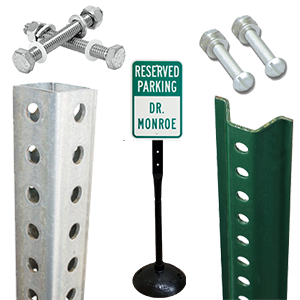
Note that we do not list these larger size of posts, although we certainly could ship these to you. The trouble is with shipping. UPS handles posts that are 8' or shorter. Longer posts must be shipped via a trucker. In most cases, the minimum trucking fee is $75.00. We have had too many customers (understandably) upset with a shipping bill that is $125 for a post that, itself, only cost $35 each. In many cases, it is easier to buy two smaller posts and bolt them together. There is further benefit too – you do not have to climb such a high ladder to drive the post into the ground. A heavy sledge hammer is tough enough to wield with two feet on the ground, let alone when you are precariously perched onto a ladder.
These types of posts are found often for signs mounted in medians. The post can be hit from any direction.
Yes, but it MUST be a graphic or logo that is 1 color. The graphic must be a .bmp, .jpg, .wmf or .tif file type.
Not currently. We offer low prices and ease of use on-line. This saves us money on catalogs and helps deliver a great value to you, the customer.
Self-inking stamps have a built-in ink pad. A patented spring device automatically re-inks the die with your image between each impression. In slow motion, you can watch the rubber stamp as it flips up and then down against the ink pad – with each impression. In general our self-inking stamps use a water-based ink. Even though they typically need to be re-inked more than pre-inked stamps, the re-inking procedure is remarkably easy and mess-free.
Pre-Inked stamps also carry their own ink. But, pre-inked stamps do not use a flip-around device – just a die that is saturated with ink. The ink seeps through the die (which is also patented) at a controlled rate. Many find that a self-inking stamps give a better quality of impression than found with a self-inking stamp.
You can proof your stamp right on-line. Just click preview and your stamp will be shown to you. No proof will be sent. This ensures you see exactly what you are getting prior to your order. And it ensures you get your stamp quickly. We have the fastest turnaround in the stamp business
Yes, we can sell you a bottle of ink or you can send the stamp back to us to be refilled. Most stamps will make 10,000 or more impressions before needing to be refilled. Traditional rubber stamps require and ink pad accessory.
Yes, but it MUST be a graphic or logo that is 1 color. The graphic must be a .bmp, .jpg, .wmf or .tif file type.
Most 50,000 impressions with reinking.
No, the ink will not dry on photos. We do offer special ink for photo stamping. Please call us to order.
Yes. Most paper types can be stamped but it may need to sit overnight to dry.
Not currently. We offer low prices and ease of use on-line. This saves us money on catalogs and helps deliver a great value to you, the customer.
Only if you order a traditional rubber stamp. Pre-inked and self-inking stamps have the ink inside the stamp body.
S&H for the first rubber stamp is typically $6.99. Higher quantities may require slightly higher shipping. We ship all stamps UPS ground unless otherwise specified in your order.
Date stamps are stamps with rotary bands that allow you to select the month, date and year. They come in a variety of stock and customizable options.
Self-Inking stamps have a sleek metal or plastic body with a replaceable ink pad housed inside. When the stamp is idle, the rubber stamp plate rests against the ink pad. When the stamp is pressed, a spring mechanism turns the rubber stamp plate to face the object being imprinted.
Pre-inked stamps hold the ink inside the pad of the stamp. Where self-inking stamps rotate to touch the pad to the internal ink pad, preinked stamps hold the ink inside the stamp rubber itself. Ink needs to be added occasionally to moisten the stamp with more color.
Numberers are stamps with changeable bands, each band containing the digits 0-9, allowing you to create a multi-digit number to imprint.