AED Signs – Usefulness at Workplaces
Imagine a colleague collapsing on the office floor, and you can’t get help to them in time because you don’t know where the AED is in your large office building.
Sudden Cardiac Arrest at Work: The Numbers
About 350,000 people in the U.S. have a cardiac arrest outside a hospital each year, and only about 1 in 10 survive, according to the American Heart Association. There are about 10,000 cardiac arrests in U.S. workplaces each year. Speed is everything: according to OSHA, a victim’s chance of survival drops 7 to 10 percent for every minute without CPR or defibrillation, and after 10 minutes, resuscitation rarely succeeds. Immediate CPR can double or triple the chance of survival.
Work factors can also strain the heart, including exposure to carbon monoxide, carbon disulfide, halogenated hydrocarbons, smoke, extreme heat or cold, and stress.
What Is an AED?
An Automated External Defibrillator (AED) is a portable device that checks a person’s heart rhythm and, if needed, delivers an electric shock to restore a normal rhythm. AEDs treat sudden cardiac arrest, which happens when the heart suddenly stops beating effectively. Cardiac arrest is different from a heart attack, which is caused by a blocked artery, though a heart attack can trigger cardiac arrest. AEDs are now common in workplaces and public places because every second counts.
How AED Signs Help?
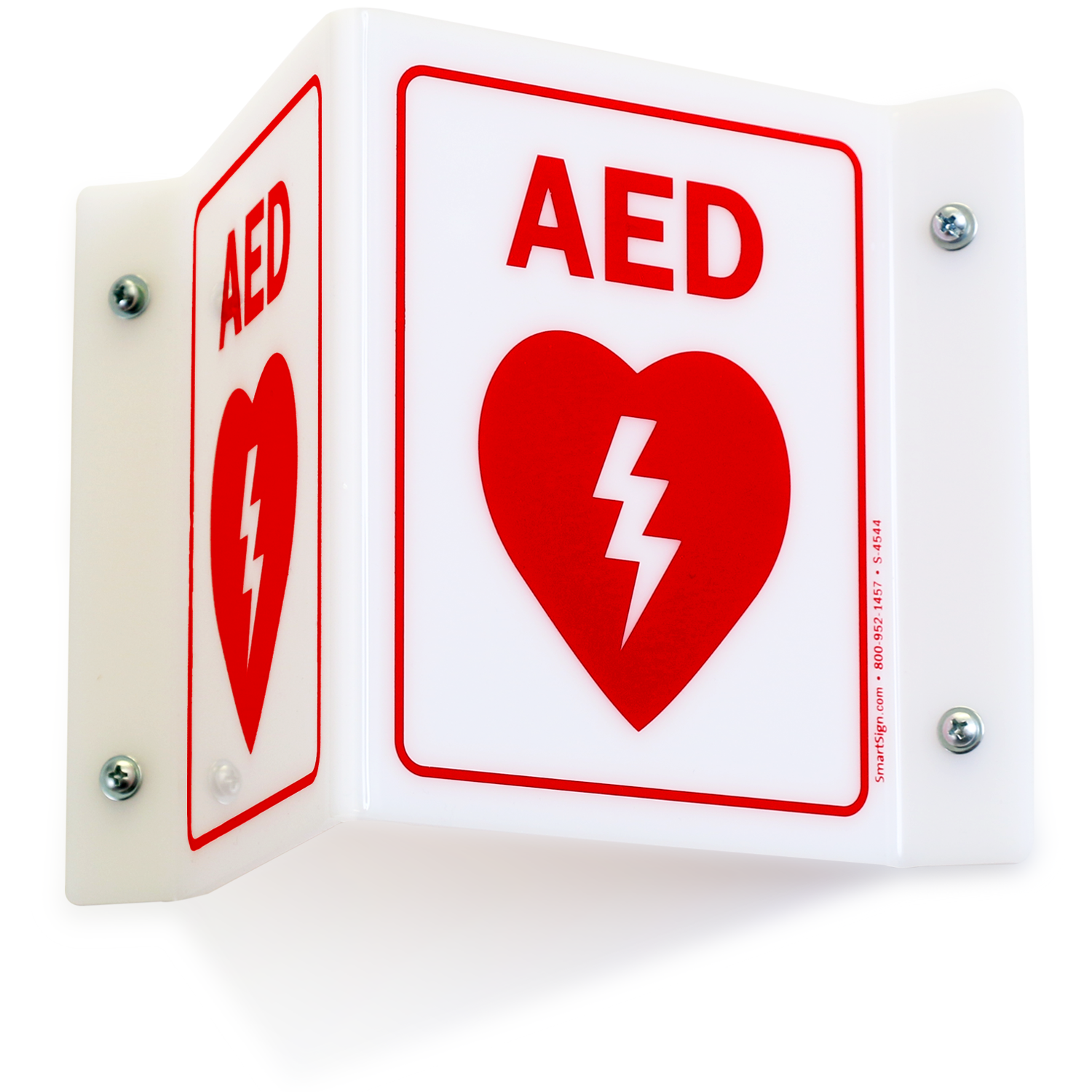
AED signs show people exactly where AEDs and first aid equipment are located, so no time is lost searching in an emergency. An AED sign mounted directly above the device is also a daily reminder that lifesaving equipment is ready to use. First aid signs help communicate the first aid arrangements in your workplace.
How to Use an AED: Step by Step?
AEDs are designed to be used by anyone, and the device talks you through each step. If someone collapses:
1. Position the victim on his back.
2. Tilt the head back and lift the chin. Check for breathing for not more than 10 seconds.
3. Till the machine is not ready, perform CPR.
4. CPR will consist of thirty compressions that are 1 and ½ to 2 inches deep. It has to be followed by two rescue breaths.
5. Make sure the surroundings are safe when AED machine arrives.
6. Tell all people to stand back.
7. Follow the instructions on the AED machine. Place one pad on the upper right side of the chest and one on the lower left side.
8. Make sure no one is touching the victim so the AED can analyze correctly.
9. AED machine will diagnose the heart rhythm and will let know if shock is required or not. Shock is applied only in the case the victim has no pulse; it is notified by the machine.
10. Machine will advise to continue CPR until another shock is issued.
11. Pay attention to what machine commands, sometimes only one shock is required.
12. Follow the instructions given by AED machine till an ambulance arrives.
These steps are a general guide and don’t replace hands-on training. The American Heart Association and the American Red Cross offer CPR and AED classes in most areas.
Like this topic? Check out our related products:
-

AED Inspection Tags
-
AED Signs