Construction Safety Signs – Necessity at Construction Sites
In one accident at a New York construction site, a 31-year-old worker was killed while working in a cherry picker. A metal pipe fell from above and struck the lift, throwing him some 20 feet to the ground. It wasn’t clear whether the worker was properly secured in the cherry picker or aware of the danger. Accidents like this are typically investigated by the Occupational Safety and Health Administration (OSHA).
Why Construction Sites Are So Dangerous?
According to the Bureau of Labor Statistics Census of Fatal Occupational Injuries, 1,034 construction workers died on the job in 2024. Falls, slips and trips caused about 38% of those deaths. Construction’s fatality rate, 9.2 deaths per 100,000 full-time workers, is nearly three times the average for all industries.
When serious accidents happen, the same questions come up: Were the construction safety signs properly posted? Did a co-worker’s mistake contribute? These questions should be answered while safety procedures are being planned, not after an accident.

Construction sites are risky work environments. Workers have to guard against hazards they may not see coming, such as high-voltage areas, falling debris and heavy equipment. A single careless error by a laborer, engineer or foreman can lead to critical injuries, permanent disability or even death. Many of these accidents can be prevented when construction safety signs are posted as the law requires.
The Role of Construction Safety Signs
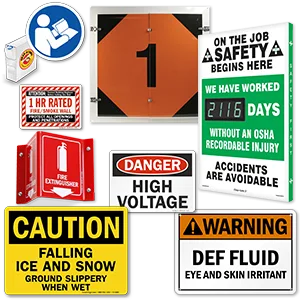
Construction companies are required to warn workers and visitors about hazards in their work areas. Proper signs at the construction site help inform workers of the dangers around them.
What Makes a Good Construction Sign
Some signs are designed specifically for construction sites. Fluorescent orange is more visible than standard orange, especially at dusk. Road construction signs should be retroreflective so they stay visible at night. Pictograms should also be part of construction signs, because they help workers who don’t read well or who speak a different language.
Sign Placement and the Rules That Govern It
The number and type of signs you need depend on where they’re used. For example, signs along a curvy road need to be placed more frequently than on a straight road. OSHA’s construction standards and the Manual on Uniform Traffic Control Devices (MUTCD) form the backbone of sign rules, and states and cities can add their own. New York City, for example, has extensive construction site safety requirements in its Building Code.
Worker Protections When Accidents Happen
Good construction safety signs help protect workers and reduce accidents and deaths, but accidents will still happen. When they do, the law provides ways for injured workers to recover.
New York
New York law places special importance on construction worker safety, covering workers injured during building construction, demolition, renovation, repair or alteration. Under Labor Law Section 240, known as the Scaffold Law, property owners and general contractors are absolutely liable for injuries from elevation-related hazards like falls and falling objects. Section 241(6) holds them responsible for violations of the state’s Industrial Code, and Section 200 covers general negligence.
Florida
In Florida, any construction employer with one or more employees must carry workers’ compensation insurance to cover on-the-job injuries. Federal OSHA rules, which apply in Florida, also require safety training and head protection, such as hard hats, where workers face a risk of head injury. Every state has a workers’ compensation system, though the rules vary from state to state.
Like this topic? Check out our related products:
-


Personal Protective Equipment Signs
-

Construction Signs
-

Hard Hat Signs